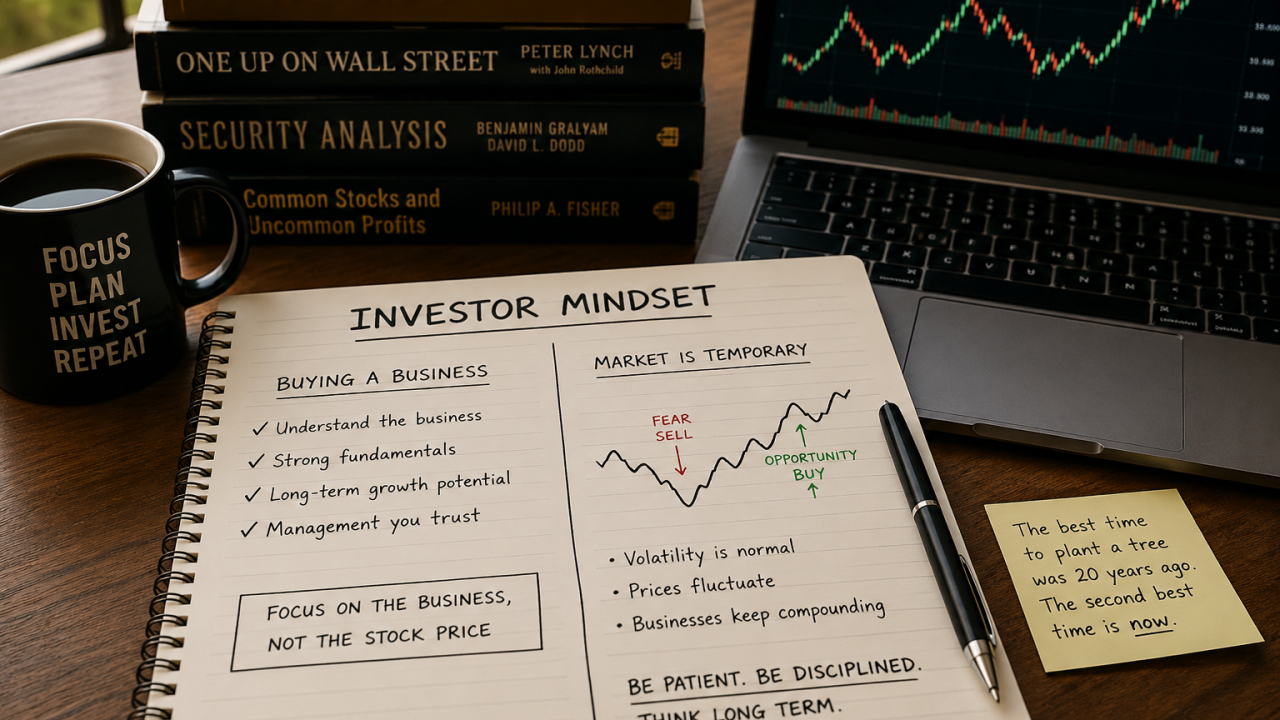
Investing Strategy
Investing vs trading a different perspective.
A year ago, I wrote briefly about the difference between trading stocks and investing in businesses. Over the past 12 months, the market has repeatedly tested that mindset.
The biggest shift for me was understanding that investing is not simply buying a stock and hoping the price rises. It is buying a piece of a business you genuinely believe in for the long term.
Today, I want to build further on that idea.
Why am I writing this a year later?
In a year's time, a lot of things have happened, especially on the global stage.
Most of the global events that occurred over the past 12 months affected people's lives and the economic market.
Tariff shocks and trade fears pushed quality stocks down.
Geopolitical conflicts and energy price spikes created uncertainty across industries and weakened many companies.
A weaker dollar translates foreign earnings into more home currency revenue, which helped support profits and valuations.
AI and tech disruption created winners in semiconductors, infrastructure, software, and cybersecurity.
Looking back at the last 12 months, if you were just getting into investing, these were impactful events that rocked your boat.
The stock market was bearish, with high volatility and overall market fear. To date, it is still not yet fully stable, and who knows when it will ever be?
This easily causes fear and disheartenment among investors, especially new ones.
How does having the mindset of buying a piece of a business rather than just another trade benefit the investor?
If the mentality is to buy a stock in the hope that it will just keep going up and be profitable, you would have seen everything crumbling down during these periods.
Every stock is in red, suffering losses across the board, creating a very uncomfortable feeling, especially for those who have never experienced it.
That goal and reasoning most probably would not have sustained for someone to hold or purchase more shares.
However, imagine this was the 'cost' of business, where the seas have grown harsher and not everything is simply green and plain sailing.
With this perspective applied at that point in time, do you think that the fear would have been on the same level?
Basic ways to identify a strong company Checking the business targets and financial stability is crucial.
This can be achieved through open source searches, going into detail, one would look into:
Its main objective, product/service being offered Demand/need of their supply, pending sales orders/promises/public contracts Growth & investment plans, Company Financials (Balance Sheet, Market Cap, P/E Ratio, Revenue v Profit Margins, Yearly Financial reports)
What does it mean when stock prices go down?
Trying to predict every market movement is difficult. What matters more is how you act when opportunities appear.
If you have a watchlist of businesses and their stock prices have just gone down because of certain common events and not business failure, what would your thinking be?
Panicking and selling what you have so you won't lose more money?
Having a perspective that there is a 'sale' / 'discounted' prices?
Giving you another window to purchase the same business at a lower price?
If a house like yours costs $100,000, and the following week the same type of house somehow now costs $50,000, what would you do?
You sell yours at $50,000, or buy 4 more?
Strong businesses with healthy fundamentals can become valuable long-term assets, even when short-term market conditions create volatility.
Just think about the mega companies we have today, Apple, Microsoft, Meta, lately Nvidia the ones we hear about every day, did they all have the same value 1,5,10, 20 years ago?
"Price is what you pay, value is what you get.”
Experience and Time
Experiencing these times firsthand will help investors understand this mentality.
From a personal experience, the stock market was crashing hard in approximately March/April 2025. I did not panic, but I did not act to the best of my ability.
Why?
I held onto my stocks because I believed in them, but I passed up the opportunity to buy them at a discount.
On the other hand, I did not panic and sell out of fear as I believed in what I was holding onto.
A similar situation occurred from the end of 2025 until a few weeks ago. On the contrary, this time I acted, I bought at a discounted price, and topped up the ones I believed in.
Opportunities like these may not appear often.
"If you aren’t willing to own a stock for 10 years, don’t even think about owning it for 10 minutes."
I am new to the stock market. When should I start?
If you are new to the stock market, one of the best things you can do is start learning early and stay consistent.
You can start today looking and purchasing broad index funds such as the S&P 500 which can be a simple way to begin understanding how markets work before moving into individual businesses.
When I first started, I diversified heavily because I lacked experience analysing companies. Some investments performed very well, while others did not, but diversification helped me manage risk while learning.
As my understanding improved over time, I became more confident concentrating on businesses I genuinely believed in.
Final Thoughts
Over time I realised that investing is not just about numbers, charts, or timing the market perfectly.
It is about conviction, patience, and understanding what you own.
Market fear will always exist.
Headlines will continue to create panic, volatility, and uncertainty.
But when you truly believe in the long-term future of a business, temporary market disruptions begin to look less like threats and more like opportunities.
The market tests not only your portfolio, but also your mindset.
Not just global conflicts and events, but even personal ones you encounter in your day-to-day life.
The difference between panic and opportunity is simply how you choose to view the situation.
Discussion
Sign in to join the discussion.
Sign inNo comments yet — be the first to share your thoughts.